Mind Mapping for Network Engineers
Introduction
I’ve had a few co-workers recently delve into the world of mind mapping. So, I decided to take a look for myself and apply it (Hello–SD-WAN). If you aren’t too familiar, a mind map is a tree-like diagram demonstrating hierarchical relationships. You have the root which is your main subject; the root has several limbs, or branches, which are sub-topics. Tony Buzan, an English author, brought mind maps into light in the 1970s. His argument is that mind maps engage the whole brain, using verbal and visual cues. I suppose Buzan’s model of neuroscience was that the left hemisphere of the brain is used for logical and verbal processing whereas the right hemisphere is used for creative and visual processing. I’m not a neuroscientist so I can’t give any insight on this. I gave a quick skim of a Harvard article. It appears that the consensus is that it’s factual that certain brain functions are located more on one hemisphere rather than the other. I’ll be honest–I felt a little underwhelmed here. The evidence appears to be pretty inconclusive. This article does reference a study that brain activity didn’t differ in terms of: did one side activate more than another? However, this article doesn’t necessarily imply that the brain laterality model is wrong. Oh well, I’m not an expert. Back to mind maps.
My Use Case
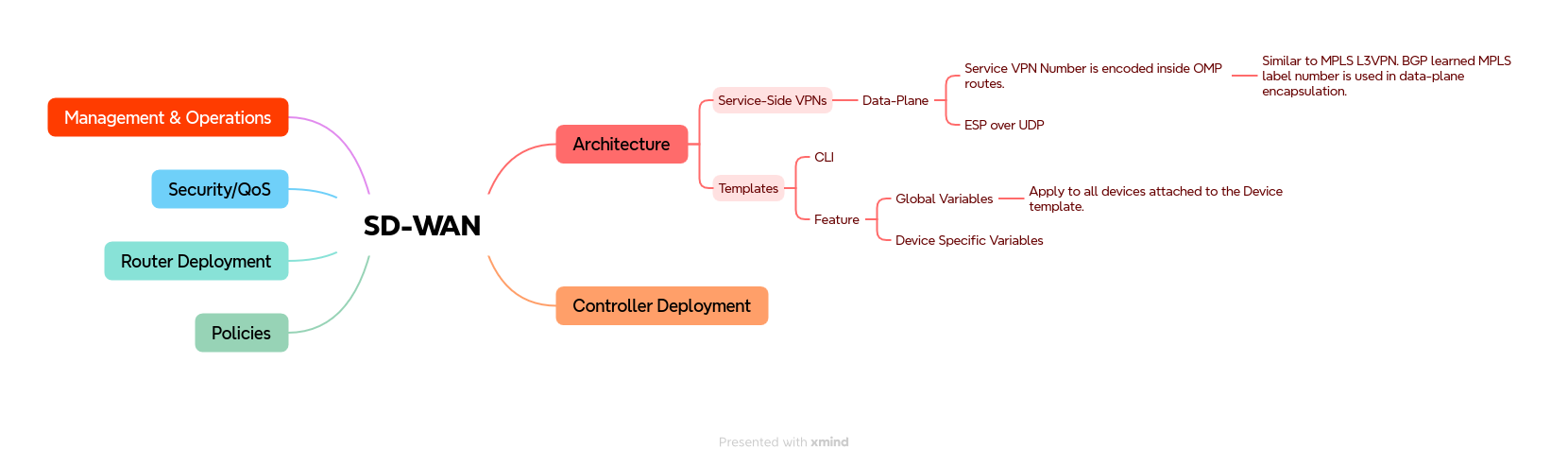
This is my first mind map that I’ve made. As mentioned, I’m studying SD-WAN for various reasons. It’s still in its early infancy, but I mapped out each of the ENSDWI exam domains. I don’t intend on taking the exam. It’s just a good reference to ensure I know the topics.
Network Engineer Use Cases
Here are a couple of workflows that I think could be useful. If you’re trying to learn a new topic, especially for work, you can use mind maps to not only use for yourself, but you can distribute them across your team as well. From an architectural standpoint, you can use mind maps to design and plan for your campus/enterprise. What business requirements are there? Any constraints? What is needed for redundancy, scalability, etc? From a troubleshooting perspective, you can use mind maps to outline possible failure domains that you’ve come across. For example, common routing issues, configuration pitfalls, etc. Then, create branches to outline diagnostic steps, commands, and anything else you’ve used to troubleshoot a particular issue. I could find this especially useful as a flow-chart for more junior people.
Verdict
It’s my belief that mind maps are helpful. Although I’m still very, very new to them, I’d argue that they’re extremely useful for rapid brainstorming, spanning across several different scenarios. If you’re learning for leisure, your job, or studying for a certification, you don’t need to comb through a lot of text. It’s not like reading a whitepaper. You can quickly parse whatever information you need.